A digital forest monitoring tool blending powerful remote sensing technology is needed for preventing forest fires. In Sattari horticultural land expansion by cutting forest and burning dried vegetation is going on uncontrolled. No awareness drive inside the sanctuaries and the forested areas have been taken to stop burning debris under dangerous weather conditions. 78% of North Goa rich forest was adoring Sattari but various anthropogenic activities have been responsible for destruction and degradation of the life sustaining forest. It is high time for all of us to plan a strategy for initiating joint forest management, consolidating the community conserved areas and providing various incentives to the local communities for the protection and conservation of the wildlife, ecology and forest.
Friday, 17 March 2023
The fires burnt the pristine forests of the Mhadei basin of Goa
A digital forest monitoring tool blending powerful remote sensing technology is needed for preventing forest fires. In Sattari horticultural land expansion by cutting forest and burning dried vegetation is going on uncontrolled. No awareness drive inside the sanctuaries and the forested areas have been taken to stop burning debris under dangerous weather conditions. 78% of North Goa rich forest was adoring Sattari but various anthropogenic activities have been responsible for destruction and degradation of the life sustaining forest. It is high time for all of us to plan a strategy for initiating joint forest management, consolidating the community conserved areas and providing various incentives to the local communities for the protection and conservation of the wildlife, ecology and forest.
Tuesday, 9 August 2022
International Day of Indigenous people
Every year, August 9, is celebrated as the International Day of Indigenous people in various parts of the world to recognise the immense contribution done by their ancestors in enriching the cultural and social aspects of our society and the role played by them in protecting and developing the land for the agricultural and horticultural crops since the hoary past.
Poverty, illiteracy, discrimination, financial instability and inequalities have been responsible for causing numerous hurdles in their path of development for the long period and due to this, they became repeatedly victims. In the United States of America, once the native Americans were attached to their land, culture and languages However, today they and their culture along with languages have been threatened. That is why,by celebrating the International Day of Indigenous people, it is the bounden duty of the Americans to recognise and respect them. Celebrating the invaluable contribution and respecting the sovereignty of the Natives, Americans are doing ideal work.
In the small state of Goa, one can experience the wonderful diversity of human culture, as this land has been connected from the ages to a wide range of communities coming from the Indian subcontinent and the world over for trade, commerce and business activities as well as understanding the land and culture.
Known as the Konkan kashi , during the ancient period and the Rome of the East under Portuguese rule, the natural beauty of the land of Goa always mesmerized the people coming from the distant regions.
Though several attempts had been made by the erstwhile Portuguese government to destroy the indigenious culture and traditions, it did not gain success in uprooting them. On December 19, 1961, the government of India through the Vijay operation liberated the Goans from the yoke of the oppressive Portuguese rule. After liberation for the long period Goa, Daman and Diu remained as the Union Territories and in 1987, Goa attained statehood. However, to recognise the indigenous people of the land, meagre efforts were made by the successive governments that came to power.
Under the banner of GAKUVEDH organisation, the indigenous people of land began the movement for their recognition as the scheduled tribes of Goa. Gauda, Kunbi, Velip and Dhangar communities by joining their hands together spearheaded the struggle.
On July 21, 1995, then MLA, Antonio D. Gaunkar, moved a private members resolution, recommending the government of Goa, to urge the central government to declare Gauda, Kunbi, Dhangar and Velip communities as the Scheduled tribes of Goa. Subsequently, the said resolution was passed in 2003. However, the Gauda, Kunbi and Velip were notified as the Scheduled tribes of Goa, excluding the Dhangar.
Since the hoary past, Goa's forest and sea biodiversity has provided an ideal home for the tribal communities, where vegetation shows variation from the tropical evergreen to mixed deciduous forest. Due to this, Goa has been providing an ideal environment for agriculture and pastoralism that has helped tribes to live happy lives.
The social organisation of the tribes in Goa constitutes distinct, endogamous groups in which the kinship was important and were politically functional as the autonomous units. They have their own general for settling the disputes. They are basically the nature worshippers; their deities are aniconic, represented by stones, ant hills, trees and other forces of nature.
Worshipping various natural entities has been given importance inside the forests, on hills by them since ages. Traditionally, they have been worshipping Mallikarjun, Somnath, Ramnath, Chandreshwar, Sateri, Kamakshi, Betal, Ravalnath… and varied forms of the folk deities associated with water, soil and forest.
For the male tribal folk, Shigmo is the most popular festival wherein a variety of folk dances along with folk songs are performed to the tune of the folk musical instruments. The rich tradition of the folk dramas like Gauda Jagor, Ranmale showcases the socio-ecological and cultural heritage inherited from the generations. The women expresses their skills of dance, drama, singing through the eco-feminist festivals of Dhalo, Katyo and Dhillo.
During the past, these communities were predominantly involved in agriculture and horticulture that relied on the vagaries of nature and that's why,they are expressing gratitude to the elements of nature through the festivals and rituals.
As they are generally characterised by long narrow head, broad nose, medium long face, short height and dark complexion, they are said to belong to the Proto-Australoid race and had migrated from Chota Nagpur region of the Central India. The technical skills inherited by them of domesticating animals, growing cereals and planting crops by digging soil with tools and implements helped to enrich the agro-horticultural heritage of the land.
They through observation developed the engineering skills by which they reclaimed the coastal and riverine land and successfully built bandhs to control the saline water. Through experiences developed the salt tolerant varieties of paddy, their staple diet of fish, curry and rice along with seasonal fruits and vegetables provided nutritional supplements. For smooth functioning of the village administration, they laid the foundation of Gavpon, where the man with immense traditional wisdom was designated as the Budhvont, a person having religious as well as cultural knowledge became the Velip and Jalmi. Gaonkar enjoyed the status among the village elders.
During Portuguese rule, the tribal communities were forced to convert to the Catholic religion, who are known as the Catholic Gaude. On 23 February, 1928, many Catholic Gaude under the shuddhi movement launched by vinayak Maharaj Masurkar were taken into Hinduism, who developed into an endogamous community known as the Nav-Hindu Gaude.
In 1962, Gomantak Gaud Maratha Samaj organisation was established to assert their rights and identity. In 1968, Goa Land Revenue Code was enforced, but very few could get possession over agricultural land that they were cultivating for generations.
In 1980, the united efforts were made by the federation of Gauda, Kunbi, Velip and Dhangar and eventually Gauda, Kunbi and Velip were included in the list of the Other Backward Communities in 1987. In 2003, the Central Government included Gauda, Kunbi and Velip in the list of the Scheduled tribes.The Scheduled tribes and other traditional forest dwellers (Recognition of Forest Rights) Amendment Rules, 2013 were introduced.
However, to enhance the social, economic, political conditions of the tribals sincere efforts are needed in Goa. Through their age -old practices, they are displaying the socio-cultural heritage deeply rooted in environmental ethics. The Sluice gates installed by them once restrained successfully the saline water. The erection of the bunds protected the Khazan agriculture land and provided foods to innumerable families. Tradition of Mange thapani, a festival of worshipping the effigies of crocodile and the inheritance of community conserved areas like the sacred groves, sacred tanks, sacred trees throw light on the linkages of them with the environment, wildlife and ecology and how, they were concerned about the protection and conservation of the natural resources by making the sustainable use.
The Dhangar community of Goa, though they display tribal traits and are earning their bread and butter through the rearing of buffalo and goat, their movement, so far has not gained success to accord them the tribal status.
Hardly few enjoy the possession over the cultivable lands for doing the agricultural and horticultural crops. Various hurdles are continuously affecting the crop productivity. Sources of livelihood are not satisfactory enough to meet their basic needs. The mining activities are also responsible for destruction and degradation of the fertile land.
August 9, is celebrated as the World Indigenous People Day to recognise and safeguard the rights of them. In Goa, there is a need to take necessary steps for protecting the eco-cultural heritage and providing impetus for encouragement of their skills and talents.
Their tangible and intangible cultural assets engrossed in traditions, customs display the intimate and lasting relationship with the surrounding nature. When appropriate forum and boost up is given for expressing the artisans and artists talents, Goa,s aboriginal culture and heritage will certainly be able to show the potentiality. Identifying and acknowledging the native land and honouring their socio-cultural contribution will enable them to get happiness.
The Christian Gaude women continued even after several years of conversion in villages of Quepem the tradition of Dhalo whereas the men folk through the Intruz performed the folk dances reciting songs inspired by the epic Mahabharata.
Sunday, 10 July 2022
Goans celebrating Ashadhi Ekadashi today
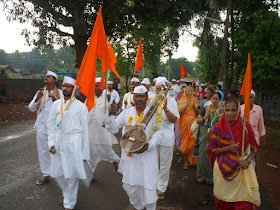
The Goans, irrespective of their caste, tribe and status, today will be celebrating the Ashadhi Ekadashi by visiting either the temples of Shree Vithal in Pandharpur of Maharashtra or in Goa.
Every year, since the hoary past, the Goans visit the temple of Shree Vithal in Pandharpur of Solapur district of Maharashtra or temples that are situated in the vicinity in Goa.
On the eleventh day of the bright fortnight of the fourth month Ashadha of the lunar calendar, every year in Goa , devotees visits in the procession by chanting the hymns composed by the saints Dnyaneshwar, Namdev, Tukaram and others to Shri Vithal temple.
The stone inscription of 1284 A.D.from Vithal temple of Pandharpur records the donation received from Lad families of Goa.
It indicates that the worship of Shri Vithal is in vogue from the later period of the Kadamba dynasty in Goa. As per the tradition, the temple of Shri Vithal was constructed on the bank of the Valvonti river in Karapur of Bicholim in 1392. Before, the construction of the temple, the devotees from Goa, were visiting Pandharpur for the Ashadhi Ekadashi and as per the folk belief, it was the intense devotion of one of the devotees, Vataba Dulba Rane Morlekar, responsible for the establishment of the temple in Goa.
In the book 'A India Portugueza' (1886) A. Lopes Mendes mentions about the temple of Vitthal, "Vithol Pagoda-deu.-In front of Mr. Raugy Ranes is the great pagoda of the god Vithol, Vithoba, on Panduranga. This Hindu temple will have two centuries of existence. it is situated on the right bank and the knight of Torlinoy-volvota, in the center of the old gentilic fortress, in the neighborhood Vitholapur, from the village of Carapur."
Gajara Raje from the house of Rane Sardesai family of Karapur, married to the Scindia's of Gwalior, helped in the construction of the present temple.
In Canacona, on the bank of the river Talpona there is Gokarna Partagali Jivottama Math established by Madhvacharya in the 13th century A. D. In this Math idols of Shri Veer Vitthal and lord Shri Ram are the main deities.
In Goa, right from Canacona to Pernem, the century old temples of Shri Vithal, attracts the devotees in processions, where varied performances of devotional songs are organised highlighting the moral values and social equality.
Sukant Avakhale, from Virdi of Sankhali, from Pandharpur, said, "Two years, due to the pandemic COVID-19, we could not visit the temple. This year, many groups of devotees traveling almost the distance of more than 350 kms on foot are participating in the festival. In order to take part in this celebration, I along with other devotees are in Pandharpur.Throughout Goa, the temples from Ponda, Sanguem, Marcel, Kumbharjua, Akhada, and other areas have been engrossed in the festival with the bhajans, kirtane and in various cultural performances.
Rajendra Phadte from Akhada island told, "Since last ten years, we after taking the blessings of Shri Vithal in the temple of Marcel comes in procession, singing the devotional songs to the temple of Pandurang in Akhada on the feet through Khandola and St.Estev."
There are evidences in Goa that indicates the name Vitthal, Vithoba, Pandurang given in the family for more than seven hundred years. The spiritual leader from South India Madhvacharya propagated the cult of Vishnu worship, Vaishnavism, many centuries before the Portuguese conquest of Goa.
Thursday, 2 June 2022
Petroglyphs of Khotale
In this area, the discovery of the petroglyphs has come to light on account of the dedicated efforts of the well-known heritage and history lover Satish Lalit, a retired officer of the government of Maharashtra. His recent publication on the petroglyphs of the Konkan region has already brought to the light the richness of the archaeological heritage.The petroglyphs have been discovered in many areas of Sindhudurg -Ratnagiri districts of Maharashtra and already some of the sites have been included in the tentative list of the UNESCO World Heritage sites which has added new feather in the glorious past of the land inherited since ages.

Khotale has the temples and shrines dedicated to Dirbaidevi, Ravalnath, Giroba, Mahapurush, Gangeshwar where various fairs and festivals are held annually and devotees throng in the big numbers. Village once was self -sufficient due to the agricultural and horticultural crops grown here and this helped them to live happily. However, nowadays, some of the villagers have been involved in the quarrying of bricks along with the cashew and mango plantation. Like people of other areas of the Konkan, villagers of Khotale, were aware about very few petroglyphs that are locally known as the Vetalachi Pavala and of Mahapurush. However, when Satish Lalit along with his wife Dr. Saee visited the site of the petroglyphs, the uniqueness and heritage value of the art came to light.
A majority of the images etched on the rocky, flat hilltops were noticed by Bhago, Shyam Modak, the residents of Dhangarwadi No.2, who have been involved in goat rearing since the last 50 years.Along with various terrestrial and aquatic animals, abstract patterns, geometrical reliefs, there are also fertility symbols that have been carved on the rock surface, the meaning of which is not known with confirmation.
After reading the news article published in the daily Marathi Herald, along with Pournima Kerkar, Gajanan Shetye, Vitthal Shelke, Sanket Naik and Palavi Naik, visited Khotale on June 2, 2022. After spending more than three hours in the scorching sun on the plateau in the search of the petroglyphs, we relished the tasty vegetarian food served by Bharati Modak.
From Goa to Oras Highway, a road proceed to Hedul via Kasal, takes to Khotale.
Thursday, 17 June 2021
Crocodile in the Goan culture
Since time immemorial, the Goans have respected the
floral as well as the faunal wealth of the land and has offered some degree of
protection to it. Not only creatures which are beneficial but harmful too have
been respected some time with fear or with awe. Crocodiles, belonging to an
ancient group of reptiles, are found on water and land. As senses of sight,
hearing and smell are well developed, the crocodile remains very alert while
basking on land. They hunt more or less in water mainly fish but any animal
that can be overcome is taken. There are numbers of folk tales and folk beliefs
prevails in various parts of India has projected crocodile as the cruel, wicked
and untrustworthy. There is a tradition of using the phrase in vernacular
languages of 'crocodile tears'. This phrase derives from an old belief that
crocodile shed tears while relishing on their prey. Crocodile tears are
considered as the false, insincere display of emotions such as hypocrite,
crying, fake tears of sorrow. Crocodiles when spend time out of water, their
eyes dry out so they weep to keep them lubricated.
There is also folk
tale where in the male crocodile was depicted to kill his friend monkey for
want of delicious heart, as requested by the wife of crocodile. Such type of
folk tales shown crocodile as unhuman. However, inspite of this, crocodiles are
respected. It is popularly believed that the number of stones in the stomach
equals the animal’s age and that 108 eggs are laid equaling in number the beads
in the Hindu rosary. In Hindu mythology, the crocodile is considered to be the
mount of Niridhe, the regent of the south west point of the compass. In
Pakistan, there is the Mangho (Mugger) Pir at Karachi which has been respected
by the locals.
In
Indian culture, the river Ganga is the holiest river and worshipped in the
sculpture as the goddess and has been depicted in iconography with the
crocodile as her vehicle. In Sattari, at Sateri Kelbai temple of Dhamshe, the
unique sculpture of eight handed goddess Ashtabhuja is shown seated in the boat
with an image of crocodile on the bank of the navigable river Mhadei, which
throws light that crocodiles are there in Goa since the period of Goa Kadamba
ruler. In many temples of Sattari, well carved wooden representations of
crocodiles were displayed. Specimens of such artefacts available in one of the
old temples in Zarme has the representation of crocodile in wooden. In the
Indian temple architecture, there was use of the mouth of crocodile in some of
the temples as the outlet for waterways. There are many stone sculptures with
the representation of crocodile mouth called as makarmukh. During the ancient
period in the, warfare, soldiers were arranged in the crocodile shape to win
the battle. This arrangement was known as the ‘Makarvyuha rachana. The design
at the entrance of the temple during the old time bear the artefact of mouth of
the crocodile called the makar toran. In the ancestral house of Mhamai Kamat in
Panaji, during the festival of Anant Chaturdashi, there is a tradition of worshipping
annually a sacred conch and also a silver idol of animal more resembling like a
crocodile.
During the sixth month of the Hindu calendar Bhadrapad, villagers of Naveli of
Bicholim assembles in the evening to celebrate the ritualistic festival of
‘Baras’. In which images of tortoise, a pair of oxen with the farmer and of
crocodile are made from kneaded flour and are worshipped. Before the onset of
the autumn agriculture, villagers worship the image of crocodile with the hope
that it may not cause any harm to them while involved in
agriculture.
Crocodile is a sanctified reptile in Goa, and its worship involves myths and superstitions Gawdas are the tribal who are engaged in the agriculture. On the bank of the estuaries in Linda, there are villages like Bhoma, Durbhat, Talaulim and Borim where on the new moon day of Pausha month, the members of Gawda community assemble near the river and make replica of crocodile by using the wet clay available in the nearby marshy areas of the waterlogged paddy fields. Clam shells are used to make the scutes and the eye of crocodiles and its teeth are made with small straight sticks. Offering of chicks are made to crocodile. Then the crocodile is worshipped with locally available flowers and vermillion which is followed by the invocation. Celebrations are held to mark the commencement of the paddy harvesting season. It is believed that the villagers decided to pacify the sea by worshipping the crocodiles, which were found in the large numbers in that area. This practice of worshipping the marsh crocodiles in some of the villages of Cumbarjua canals is popular locally as the Manage Thapani. Once, symbolic worship of crocodile in vogue Mulgaon of Bicholim. It is also said that in order to get protection from power and cunning abilities of crocodiles, this tradition came into practice and is still continued.
Thursday, 13 August 2020
Hanumant Gad
Fukeri surrounded by Zolambe, Bhekurli, Khadpade, Gharpi and Asaniye, is one of the beautiful village of Sindhudurg district with 593.96 ha area, village has the population of 309 with 79 houses. After crisscrossing serpentine ghat road from Zolambe one reach to Fukeri where the sacred grove protected by villagers welcome. Without understanding the eco-sensitiveness of the area and annual downpour of the monsoonal rain the ghat road was built. However, during the rainy season the land slides causes hurdles for the villagers of Fukeri.